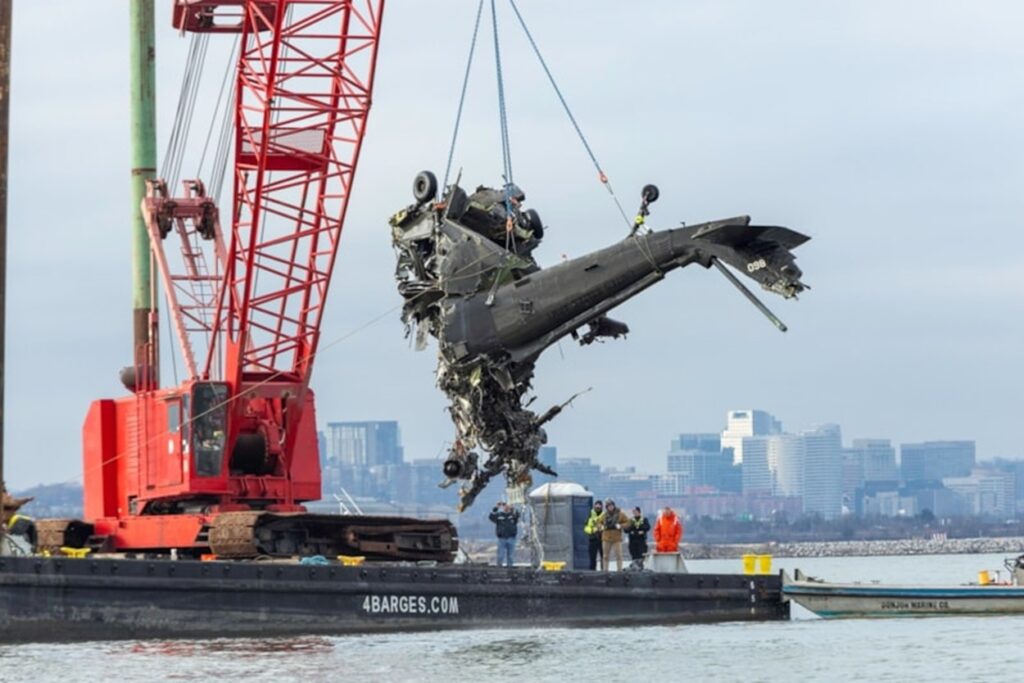
The U.S. government has admitted that the actions of an air traffic controller and U.S. Army helicopter pilots contributed to the deadly midair collision last January between an American Airlines commercial plane and an Army Black Hawk helicopter near the nation’s capital, killing all 67 people aboard both aircraft.
The passenger jet was carrying 60 people, including a group of elite young figure skaters, their parents and coaches, and four crew members, while three soldiers were aboard the helicopter.
In its official response Wednesday to the first lawsuit brought by a victim’s family, the government said it is partly liable because an air traffic controller violated visual separation procedures the night of the crash, according to the Associated Press. The filing also cited the Army helicopter pilots’ “failure to maintain vigilance to see and avoid’ the passenger jet as a contributing factor.JUST IN | January DC Midair CrashRecent court documents reveal the U.S. government’s admission of failures related to the January midair collision between a military helicopter and a commercial plane. Court filings say the government admitted Army helicopter pilots failed to… pic.twitter.com/JBjk0BFC3b— Citizen (@CitizenApp) December 18, 2025
The crash, which happened as the airliner was about to land at Ronald Reagan National Airport (DCA) in Arlington, Virginia, was the deadliest aviation accident on U.S. soil in more than two decades.
At least 28 bodies were recovered from the icy waters of the Potomac River following the crash.
The government’s response noted that others, including the flight crew of the jet and the airlines involved, may have also played a role. The lawsuit names American Airlines and its regional partner, PSA Airlines, alleging that they failed to adequately mitigate the risks of operating near helicopter traffic around Washington, D.C., and did not provide sufficient training to pilots to handle such situations. Both have filed motions seeking dismissal from the lawsuit.
The government has also denied that any air traffic controllers or officials at the FAA or the Army were negligent.
An attorney representing the family of victim Casey Crafton stated that the filing constitutes an admission of responsibility by both the Army and the FAA, while also acknowledging the alleged roles of the airlines, according to the Associated Press.
“The families of the victims remain deeply saddened and anchored in the grief caused by this tragic loss of life,” attorney Robert Clifford said.
Government attorneys wrote that the United States “admits that it owed a duty of care to plaintiffs, which it breached, thereby proximately causing the tragic accident.”
American Airlines declined to comment on the filing. In the airline’s motion to dismiss, it argued that legal responsibility lay with the federal government, not the carrier, and that it remained focused on supporting the victims’ families since the crash.
The NTSB is expected to release its final report on the crash early next year, but investigators have already identified several contributing factors.
Among them: The Black Hawk helicopter was flying about 78 feet (24 meters) higher than the 200-foot (61-meter) altitude limit for its route, reducing separation between helicopters and aircraft landing on Reagan National’s secondary runway. The NTSB has also said the FAA failed to adequately address safety risks around the busy airport despite 85 near-miss incidents in the three years preceding the crash.
The government acknowledged in its filing that it was aware of previous near-miss events involving Army-operated Black Hawk helicopters and aircraft operating along helicopter routes near Washington.
Before the collision, the air traffic controller twice asked the helicopter pilots whether they had the jet in sight. The pilots confirmed visual contact and requested approval for visual separation, a practice FAA official later acknowledged had become overly relied upon at Reagan National. The FAA has since ended the practice at the airport.
Witnesses told investigators they questioned whether the helicopter crew could clearly see the airliner while wearing night-vision goggles and whether the pilots were looking in the correct direction.
Investigators have also said the helicopter crew may not have realized how high they were flying because the barometric altimeter they relied on was reading between 80 and 100 feet (24 to 30 meters) lower than the altitude recorded by flight data systems.
Richard J. Levy, a retired pilot and aviation litigation expert witness, said the government’s admission of partial responsibility less than a year after the crash is uncommon, according to the Associated Press.
“They would not have done that if there was a doubt in their mind about anything the controller did or that the Army did,” Levy said.RELATED ARTICLES:NTSB finds black boxes, searches for answers in Potomac midair tragedyLatest on midair between American Airlines CRJ, Army helicopter at Reagan NationalNTSB urges FAA to prohibit, alter helicopter routes after Potomac midair



Recent Comments